Photo: Brian A Jackson/Shutterstock
Development in disruption
The Trump Administration’s closure of USAID, dismissal of some 95% of its employees, and the cancellation of much of U.S. development assistance[1] have hyper-charged ongoing, simmering discussions about reforming development assistance. This piece delves into one of those discussions and concludes by identifying three additional emerging dialogues. While focused on the U.S. context, these ideas are broadly relevant to how other donors manage development assistance.
The specifics of what follows are not new and do not comprise a new aid architecture but hopefully will contribute to efforts to improve foreign assistance over the coming difficult period. A key theme is the inter-connected web of factors that contribute to effective and sustainable U.S. foreign assistance. Equally essential are knowledgeable staff who utilize deep expertise, trusting relationships, and evidence-informed approaches. Their patience and long-term focus are critical in leading the management and implementation of development assistance. The need of core capacity and skills for development at the State Department is highlighted in a recent report from the Modernizing Foreign Assistance Network.
Broader global context
The conversation of “old aid” to “new aid” cannot be separated from larger changes in the global context. Five key trends illustrate this context:
1. International Order: The U.S.-led post-World War II international order has been waning as the 21st century progresses. Recent U.S. withdrawal from international commitments has broken trust in U.S. global leadership and sped up the already existing fragmentation into a multipolar, multi-institution (public and private –governments, business, civil society organizations) world. The impact is likely to be seen in international engagement and initiatives (rather than broad international agreements) involving shifting and transactional alliances, coalitions of “the willing” comprised of self-selected governments and sometimes private organizations, and regional groupings. A prime example of the disruption is the Trump Administration’s approach to the UN, highlighted by the U.S. disengaging from 31 UN organizations (along with 35 other international organizations). At the same time, the U.S. used selected agencies – OCHA specifically – to funnel additional funding.
2. Global challenges: The traditional development objectives such as poverty alleviation and economic growth now coexist with a broader range of global challenges: climate change, historic levels of migration and “permanent refugees,” potential pandemics, and the impacts of digital development and artificial intelligence.
3. Global South Development: Many countries in the Global South are gaining capacity and demanding to chart their own development path. According to the World Bank country income classification, in 1987 30% of countries were classified as low-income; by 2023, that share fell to 12%; while the high-income category moved from 25% to 40% of countries.
4. Official Development Assistance (ODA): ODA fell 7.1% from 2023 to 2024, the first decline in six years. Projections from Donor Tracker indicate that from 2024 to 2026, 14[2] of the 18 largest official bilateral donors are expected to reduce ODA, with the largest reductions from the two largest donors, United States and Germany. Only four[3] are expected to have modest increases. As a result, ODA is expected to decline from $198.54 billion in 2024 to $145.34 billion in 2026 – a reduction of 27%. With rising demands for funding for defense and domestic priorities, near-term reversal of this trend is not expected.
5. Donor Fragmentation: We likely have seen the heyday of the OECD Development Assistance Committee (OECD). The donor community is increasingly fragmented. One can envisage a group of European countries plus Canada, Australia, and New Zealand following a more traditional DAC approach; the U.S. (at least for the next several years) and others pursuing a more transactional approach; BRIC countries offering a more South-South approach; and private philanthropy (currently only 5-6% of ODA) taking a marginally larger role focused on civil society.
Hindrances to development effectiveness
In considering how “old aid” needs to be modernized, it is important to acknowledge the positive side. Development assistance programs have made meaningful contributions over many decades. The vast majority of activities are purposeful, well managed, and produce concrete results for individuals and communities and at times entire nations and the global community.
Yet the buildup of excessive bureaucratic requirements, as noted 30 years ago by former speaker of the House Jim Wright in his 1996 biography[4], and more recently by Erza Klein and Derek Thompson in Abundance, where they describe government “obsession with procedure,” occurs even with well-designed government programs, and has overburdened many aspects of the development architecture. Therefore, it’s an appropriate moment to consider various aspects of the future of development assistance and candidly identify shortcomings.
Common obstacles to timely and effective implementation include:
1. Fragmentation through too many small projects that collectively don’t add up to development.
2. Excessive paperwork and time consumed in procurement and accountability.
3. Targets and indicators that emphasize outputs rather than impact and often become the goal in place of the intended development results.
4. Insufficient patience, with pressure for short-term outcomes in contexts that require long-term engagement.
5. Programs driven by congressional earmarks, directives, and executive branch priorities that don’t respond to local needs.
6. Limited local ownership, including inadequate involvement of local actors, buy-in, and insufficient use of local systems.
7. Reliance on parallel structures to circumvent government ministries and processes.
8. Accountability to donors rather than to local communities.
9. Risk aversion, which limits innovation.
10. Limited transparency in aid data and decision making.
Elements for constructing a modern development effort
In thinking how to move toward an updated development architecture, it is useful to identify potential elements. What follows should be understood as a menu, not a plan, and that not all are mutually compatible.
1. Development goes beyond aid: Development is not primarily about assistance. It is shaped by a broader set of dynamics that impact national and global progress, such as trade and investment, government policies and regulation, knowledge and expertise, and the business environment.
2. Locally led development (LLD): LLD has increasingly become a governing principal of development. But it must be paired with Co-development – collaboration or interoperability between national and global stakeholders – which is essential in our interdependent world.
3. Government-to-Government (G2G) engagement and domestic resource mobilization (DRM): G2G and DRM are key instruments for advancing LLD through improving the capacity of partner governments and enabling the generation of local financial resources.
4. Achieving scale: To have real impact, development efforts must reach scale. This is accompanied by greater collaboration among donors, fewer fragmented projects, and a stronger focus on systems and institutions. Examples of scaled efforts in U.S. development assistance include initiatives such as Power Africa, Feed the Future, PEPFAR, and the President’s Malaria Program, as well as global efforts like the Green Revolution and the Global Financing Facility.
5. Moving from coordination to collaboration: Effective development requires donors to move beyond pro forma coordination toward active collaboration – working toward shared objectives and in compatible ways. One approach is the use of national platforms comprised of donors, the partner government, the private sector, and local stakeholders.
6. Designing for sustainability: Sustainability has been and must remain the byword of development. In Lean Impact, Ann Mei Chang adapts the Silicon Valley methodology of starting small and making adjustments until reaching proof of concept. She suggests that the design phase of activities should encompass the concepts of: (1) reaching scale and (2) sustainability – meaning who/how the activity is to be continued when the donor/Northern partner has moved on. Eighty years of development experience suggests that too many projects have failed because they were never full anchored in locally led development – the foundation of sustainability.
7. Simplification: Development programs can often be more effective if they are simpler and more focused. This could involve:
· Setting fewer objectives that are ambitious but realistic
· Concentrating programs on a few key elements of development (as the MCC targets one or two core constraints to growth)
· Streamlining procurement and reporting requirements, best achieved by moving from complicated cooperative agreements and contracts (which require extensive paperwork, commitments, and accountability) to simpler grants and core support.
8. Investing in public goods: These investments spread out and minimize costs to partner countries to meet critical needs and avoid vendor lock-in. For example, Digital Public infrastructure (DPI) allows core systems to be built once and then adapted by each country and community.
9. Engaging the private sector: The private sector is essential to economic growth and development. USAID’s 25-year experience with roughly 20,000 public-private partnerships offers a model of engaging with not only corporate philanthropy, but with the business operations of companies which have the potential of reaching scale and sustainability. These collaborations also require donors to modify procedures to adapt to the operating modes of the private sector.
10. Flexibility and adaptability: Donor programs must have flexibility and nimbleness to respond to changing circumstances and partner stakeholder priorities and needs. This includes moving away from congressional earmarks and directives.
11. Cash transfers: Putting cash in the hands of families and communities has proven to be a quick and cost-effective means of support. This approach is especially effective in humanitarian circumstances, but also in supporting family well being while boosting the local economy.
12. Digital technology and artificial intelligence: Digital systems and AI will shape economic, social, and political development going forward. The experience of Ukraine is a striking example that digital hard and soft ware are critical in today’s world for security, economic, and social welfare. Based on 10 years of public-private collaboration building government digital capacity, upon the 2022 invasion by Russia, Ukraine quickly created means for communicating virtually with, and extending services to, citizens wherever they might be and to make the country more resilient in the war effort. With its advance digital and AI capacity, the United States is well positioned to help build digital capacity in developing countries. Digital, AI, and block chain can make assistance more creative and efficient, including by improving data monitoring, reporting, and evaluation.
13. Innovation and risk tolerance: Development often involves uncertainty and adaptation. Applying proven solutions to different circumstances and experimenting with new approaches requires an environment that encourages innovation and calculated risk taking. Congress, agency inspector generals, General Accounting Office, and the media need to recognize that not all assistance programs will be successful and important lessons can be learned from mistakes and failure.
14. Accountability and learning: Strong systems for monitoring, evaluation, learning, and transparency are essential to ensure that development assistance is effective and efficient, that intended beneficiaries receive support, and that taxpayers’ resources are well used.
15. Investing in talent in country: Development is people. Development requires staff that are knowledgeable, well trained, and innovative. Possibly the best way to contribute to development, consistent with the locally led approach, is to help train the next generation so citizens of partner countries are better able to choose their own path. The dismantling of USAID led to the loss of tens of thousands of local staff (Foreign Service Nationals – FSNs) who worked at USAID missions in providing technical and cultural knowledge critical to the success of U.S. assistance. In earlier decades, USAID also ran extensive participant training that brought tens of thousands of early and mid-career professionals from developing countries to the United States for a range of programs from short-term training to PhDs. Many later became public and private sector leaders in their countries. Taking advantage of one of our great assets – our system of higher education – while building a two-way brain exchange and advancing U.S. soft power – could make a significant contribution to development.
16. Workforce: For donor operations, ensuring that programs are well run and effective requires an adequate cadre of staff with expertise in program management (design, strategy development, procurement, oversight, evaluation) and in technical skills (health, education, energy, business development, economics, democracy, finance, governance).
Linking the elements
This final point on staffing is the jumping off point for connecting these various elements.
With more than 95% of USAID’s experienced staff having been abruptly dismissed, leaving some 700 from what was a cadre of more than 10,000 for managing foreign assistance – the reality of a much smaller and less developmentally experienced staff may become a defining constraint.
A development system operating with fewer staff will inevitably need approaches that are simpler, more collaborative, and more locally driven. In that sense, staffing realities may serve as the thread that links several of these ideas:
· Locally led development facilitated by grants and core support for the missions of local organizations
· G2G and DRM empower and aligns local capability, decision making, and finance, thereby advancing LLD
· Collaboration with other donors and the private sector, especially via country platforms that bring donors and local stakeholders together to work at scale and build the finance needed
· Expanding local development to co-development via international collaboration – among government entities, INGOs, contractors, and private companies at the local, national, and international level
· Simplification through fewer countries, fewer objectives, a few public goods, simpler processes focused on a few critical constraints to development
· Flexibility and nimbleness through simplification and less donor directiveness
· Scale aligns with fewer projects, focusing on systems and institutions, and collaboration among donors.
· Public goods offer a way for donors to collaborate and work at scale.
· Digital and AI facilitates innovation, simplification, nimbleness, scale, and reporting.
· Cash supports locally led development, simplification, nimbleness, and scale.
· Cash & Digital interact to engender speed, nimbleness, and scale. For example, at the beginning of the Covid pandemic Togo using its digital platform to put cash in the hands of families in just a few weeks, not the months it took the U.S. to mail checks and send money to our bank accounts.
· Accountability is essential for providing transparency and assurance to donor taxpayers and Global South partners and citizens that development assistance is well used.
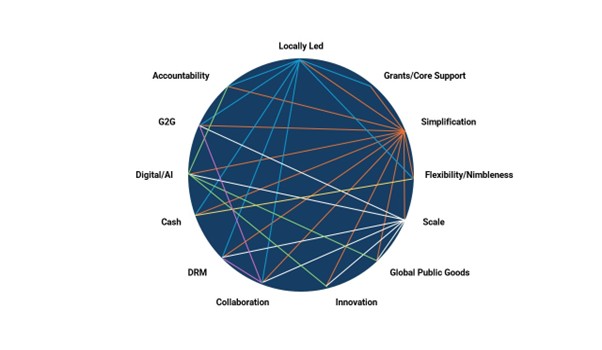
The multiple interlinkages are illustrated in the image below. The specific lines in the globe are less important than the overall pattern they suggest. Different observers may see different connections, but the key point is the interconnectedness across all the elements – and how collectively they can improve the manner in which development assistance is designed and delivered.

Two of the elements standout as north stars for the development business.
The first is locally led development. Given the progress in the Global South, increasing calls for decolonialization of development, and the decline in official development assistance, placing local actors in the driver’s seat is clearly aligned with the direction of history. It is a matter of equity, effectiveness, and sustainability – who is going to be around at the end of the day to sustain the activity.
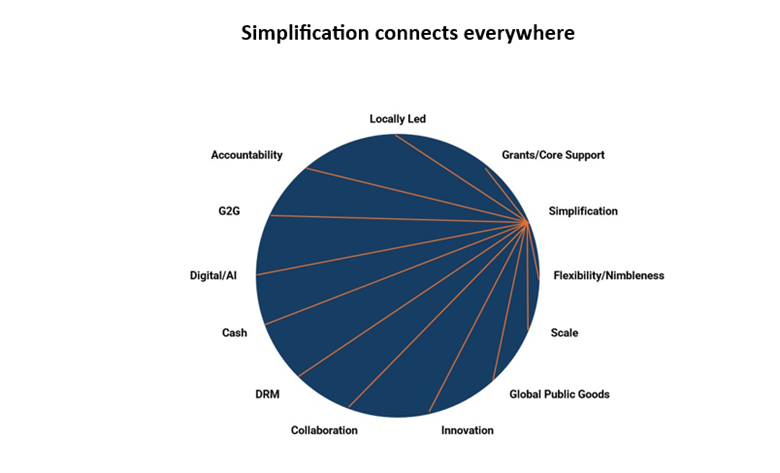
The second is simplification. The image below is particularly revealing in showing how simplification connects to every element in the globe. Without question, simplification can be overdone. Development is inherently complex, involving many knowns and unknowns. Yet focusing on the essentials, while not ignoring the complexity, in-depth expertise, and resources needed for design and management assistance, is critical and should serve as a touchstone to be kept uppermost in mind in designing and implementing development assistance programs and processes in order to avoid unnecessary, burdensome underbrush that interferes with execution, accountability, delivering results, and messaging. Trying to reduce development to a few core determinants, a core principle for the Millennium Challenge Corporation, is not a new endeavor. As far back as 1989, the House Committee of Foreign Affairs carried out a review of foreign assistance, concluding with a report that recommended reducing the 33 objectives for development assistance scattered through the Foreign Assistance Act to four – “economic growth, environmental sustainability, poverty alleviation, and democratic and economic pluralism. [5]
Shifting the focus
Bringing together areas for improvement and strength requires rethinking how we work and who we empower. It would involve a numberof strategic shifts:
· from complex to simple
· from aid-centered to ecosystem-centered
· from donor led to locally led
· from donor priorities to the missions of local institutions
· from fragmentation to scale
· from contracts to cash
· from analog to digital
· from risk-averse to risk-smart
· from processes driven by rules and outcomes to program impact
· from coordination to collaboration
· from accountability for box checking to accountability for learning
Action Priorities:
To execute these changes, key actors need to change their behavior:
· Donors: Redesign procurement and risk protocols to simplify and enable true local ownership and co-creation driven by partner country stakeholders.
· Implementers: Contractors and INGOs must evolve from grant-seekers to solution-scaling partners for Southern stakeholders.
· Multilaterals: Serve as “platform orchestrators” to pool resources and harmonize goals.
· Congress: Reduce earmarks, allow programmatic flexibility, and insulate aid from performative backlash.
· All actors: Shift from a frame of development cooperation being supply-offered to demand-driven.
Learning from the Past
A useful starting point to update or redesign the next phase of development assistance is to revisit lessons from the 1990s “reengineering” of USAID, part of Vice President Al Gore’s government-wide National Performance Review. That effort sought to better focus programs and remove burdensome elements of USAID processes[6]. However, despite these good intentions, some reforms led to additional burdens. For example, the push to make USAID more results-orientated led to the development of a complex of indicators. In practice, implementation focused more on outcomes, which were easier to measure, than results. This led to a focus on meeting indicators rather than impact on development. It also produced large volumes of reporting that were seldom read and had little impact on program impact.
Other Dialogues
This piece has walked through one approach, drawing an ongoing conversations of ways to improve traditional elements of development assistance. At the same time, other conversations are taking place alongside discussions of reform.
One is decolonization. Some argue that development assistance is a form of economic colonialism, a dependency of the South on the North. One can envision how to reduce a part of the colonial nature of development – through locally led development grounded in intentionality to transition decision making and control to partner central and subnational government, community and civil society organizations, and the private sector. However, while locally led development may reduce dependency, it cannot eliminate it entirely. In an increasingly interdependent world, development relationships are best understood as forms of balanced interdependence that can benefit both South and North.
A second discussion is how to link development assistance with foreign policy and security. Advocates of closer integration argue the rationale for this approach is that integration of development with the other two in policies, programs, and bureaucratically is important as the overriding global challenge is a foreign policy challenge - the disruption by China and Russia and others to the international order. In fact, merging development assistance into the foreign affairs bureaucracy is an age-old debate which the current disruption has rekindled. The immediate concern of developmentalists is how to preserve long-term development effectiveness with aid embedded in an institution driven by short-term foreign policy goals.
A third conversation, which has not yet taken place, but should, was referenced earlier, that development is not primarily about assistance. Rather it is about the broad sweep of dynamics that affect national and global progress such as trade, investment, finance, government policies and regulation, knowledge and expertise. Putting aid into this broader context would help identify where it can be most useful and effective.
In Conclusion
As stated at the outset, this essay does not provide a new design for international development. It addresses many of the components of development assistance in hopes of contributing to improving its execution while a new architecture – or likely several different architectures – emerge from the system that has evolved over eight decades and now is undergoing serious disruption.
[1] This paper deals with economic development assistance, not other types of foreign assistance – humanitarian, security, and military – although theanalysis has implications particularly for humanitarian assistance.
[2] Australia, Belgium, Canada, France, Germany, Ireland, Korea, Netherlands, Norway, Sweden, Switzerland, UK, U.S., EU.
[3] Denmark, Italy, Japan, Spain.
[4] Jim Wright, Balance of Power
[5] Committee on Foreign Affairs, “Report of the Task Force on Foreign Assistance”, February 1989. To be transparent, the author of this essay was the principal committee staff lead on this study and the report, led by Representative Lee Hamilton(D-Indiana).
[6] The specific objectives covered eight areas: “procurement reform, financial management reform, streamlined organization, results-oriented government, reform of the personnel system, regulatory management, information policy and technology, and customer service improvements.” From Donald F. Kettl and John J. Dilulio, Jr, editors, Inside the Reinvention Machine: Appraising Government Reform, Brookings Institution, 1995.